
- Home
- The Clinic
- Pathologies
- Techniques / Technology
- INUSpheresis®
- Clinical Analysis
- Blog
- Contact
Trigeminal neuralgia (TN), also known as painful tic, is considered by many to be one of the most painful diseases known to humankind, and has been labeled the "suicide disease" due to the significant number of people who took their own lives before effective treatments were discovered. It is probably one of the worst types of pain known to man. It is estimated that one in every 15,000 people suffers from trigeminal neuralgia, although the numbers may be significantly higher due to frequent misdiagnosis. Trigeminal neuralgia is relatively rare. It is estimated that one million people worldwide suffer from trigeminal neuralgia. It usually develops after the age of 40 and affects women at a ratio of 2:1.
Trigeminal neuralgia results from a disorder of the trigeminal nerve and is thought to be caused by irritation of the trigeminal nerve. This nerve provides sensation to the face, teeth, mouth, and nasal cavity and also allows the muscles of the mouth to chew. The fifth cranial nerve provides sensation to almost the entire face, which explains why the disorder can cause pain in different areas of the face. Trigeminal neuralgia is the most common of all neuralgias.
People with trigeminal neuralgia suffer from intermittent severe pain that interferes with common daily activities such as eating and sleeping. They live in fear of unpredictable painful attacks. It is an acute, penetrating disease, similar to electric shock pain in those regions of the face served by the trigeminal (fifth) cranial nerve (CN V). The V cranial nerve affects three areas of the face: the forehead and eyes, the cheeks, and the jaw. Although trigeminal neuralgia cannot always be cured, treatments are available to relieve the excruciating pain. Historically, anticonvulsant medications were typically the first treatment option. In trigeminal neuralgia, painful attacks can occur frequently over the course of a few hours to several weeks at a time, and then subside for a period of weeks or months. Each attack can last from a few seconds to a maximum of 2 minutes. It can go into remission or stop completely for months or years.
Pain can be better controlled through the use of interferential stimulation (IFT), as treatment can be administered before pain sets in. With the portability of the Infrex Plus unit, patients can be treated as needed wherever they are. IFT provides immediate sensory relief and prevents pain or reduces its severity. Because the face has less moisture due to the types of tissues, interferential treatment may be better when used in conjunction with moist packs, as this allows greater penetration of the interferential current to block pain to the brain. Eliminating the first primary attacks with interferential therapy may prevent future attacks.
Unlike drugs, the effectiveness of interferential treatment is immediate for the patient. Relief is instantaneous when treatment begins and can be long-lasting due to the physiological changes caused by the interferential treatment itself. It is not uncommon for a 30-minute interferential treatment to be sufficient to stop any recurrence of pain for months. With prolonged use, when necessary, trigeminal neuralgia can potentially be effectively eliminated and the patient remain free of the disease.
El principio básico de la terapia interferencial es la utilización de los significativos efectos fisiológicos de la estimulación eléctrica de baja frecuencia (<250pps) en los nervios, sin el dolor asociado y los efectos secundarios algo desagradables a veces asociados con la estimulación de baja frecuencia. Recientemente, numerosos dispositivos interferenciales €œportátiles€ se han hecho fácilmente disponibles. Pese a su tamaño, son perfectamente capaces de realizar la terapia interferencial €œadecuada€, aunque algunos tienen una funcionalidad y capacidad limitada para que el practicante pueda utilizar todos los parámetros. La mayoría de estimuladores multifunción incluye todos los modos interferenciales, por lo que el practicante tiene varios tipos de máquinas para elegir.
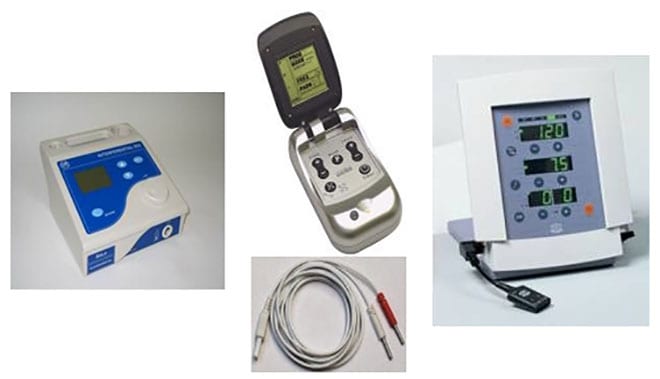
When producing low-frequency effects of sufficient intensity and depth, patients may experience discomfort in the superficial tissues (in the skin). This is due to the impedance of the skin, which is inversely proportional to the stimulation frequency. The lower the stimulation frequency, the greater the impedance to the passage of current. The impedance of the skin at 50 Hz is approximately 3200, while at 4000 Hz it is reduced to approximately 40. The result of applying a higher frequency is that it will pass more easily through the skin, requiring less electrical energy input to reach deeper tissues and resulting in less discomfort.
Electrical stimulation for pain relief has widespread clinical use, although the direct scope of TENS in this role is limited. Logically, higher frequencies (90-130Hz) can be used to stimulate pain output mechanisms and thus mask pain symptoms. Alternatively, low-frequency stimulation (2-5Hz) can be used to activate opioid mechanisms, providing a degree of relief. These two different modes of action can be explained physiologically and will have different latency periods, varying the duration of the effect.
Electrical stimulation is also used for muscle stimulation. There are other special applications in which IFT has been used. These include stimulation as part of the treatment of incontinence and pelvic floor training (e.g., Parkkinen et al., 2004), constipation in children (Chase et al., 2005, Queratto et al 2013, Yik et al 2012), fibromyalgia (Almedia et al, 2003; Raimundo et al, 2004), and trigger point intervention (Hou, 2002; Jenson et al, 2002). Improved fracture healing has also been investigated with mixed results (e.g., Ganne, 1988).
A recent article in the Journal of Headache and Pain has examined a collaborative referral and treatment strategy that could be highly beneficial for patients with trigeminal neuralgia.
The article examined the effectiveness and strategy of an accelerated management program at the Danish Headache Center (DHC) for trigeminal neuralgia. The main objectives of the strategy were to establish a collaborative protocol, ensuring in particular a correct diagnosis, excluding secondary causes of pain, optimizing medical treatment, and educating patients on how to use medications appropriately to manage pain and minimize side effects, and determining the need for neurosurgical intervention when necessary.
