
- Home
- The Clinic
- Pathologies
- Techniques / Technology
- INUSpheresis®
- Clinical Analysis
- Blog
- Contact
Raynaud's phenomenon is a term that refers to color changes (blue, white, and red) that occur in the fingers and sometimes the toes. Raynaud's syndrome usually appears after exposure to cold temperatures. It happens when blood flow to the hands, fingers, or toes is temporarily reduced. Raynaud's can lead to finger swelling, color changes, numbness, pain, skin ulcers, and gangrene in the fingers and toes. People with Raynaud's disease may have other diseases, and some people with Raynaud's may not have any other diseases.
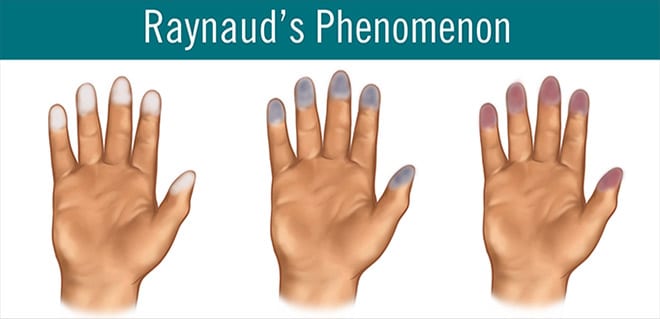
In patients diagnosed with scleroderma, Raynaud's phenomenon, digital ulcers, and calcinosis are common manifestations. Digital ulcers occur in more than half of patients.
Raynaud's phenomenon occurs in two main forms:
Symptoms of secondary Raynaud's often first appear later in life, around age 40, while people with the primary form usually have symptoms earlier.
The blood vessels in the hands and feet appear to overreact to cold temperatures or stress. When the body is exposed to cold temperatures, the hands and feet can lose heat. The body slows down the blood supply to the fingers or toes to preserve core temperature. It specifically reduces blood flow by narrowing the small arteries under the skin of the fingers. In people with Raynaud's, this normal response is exaggerated. Stress causes a reaction similar to cold.
In Raynaud's, the arteries in the fingers enter a state called vasospasm. Vasospasm occurs when blood vessel spasms cause the blood vessels to narrow, critically and temporarily limiting blood supply.
These same small arteries may thicken slightly, further limiting blood flow. The affected skin becomes pale and dark in color due to the lack of blood flow to the area. Once the spasms subside and blood returns to the area, the tissue may turn red before returning to its normal skin color.
Cold temperatures are more likely to trigger an attack. Exposure to cold can be as simple as putting your hands under a cold running tap, taking food out of the freezer, or being exposed to cold air. For some people, exposure to cold temperatures is not necessary. Emotional stress alone can cause a Raynaud's episode. Raynaud's syndrome may be partly a hereditary disorder.
The causes of secondary Raynaud's include:
Care and preventive measures, such as wearing gloves or heavy socks, are usually effective in treating mild symptoms of Raynaud's. If these are inadequate, medications are available to treat more severe forms of the disease. The goals of treatment are:

Depending on the cause of the symptoms, medications can help treat Raynaud's syndrome. To widen (dilate) blood vessels and promote circulation, your doctor may prescribe:
In cases of severe Raynaud's, medications may be inadequate, so your doctor may explore other treatment options:
Hyperthermia, a heat radiation method that uses infrared A rays and filtered water to raise body temperature, promotes rapid heat distribution throughout the body while only slightly affecting the epidermis.
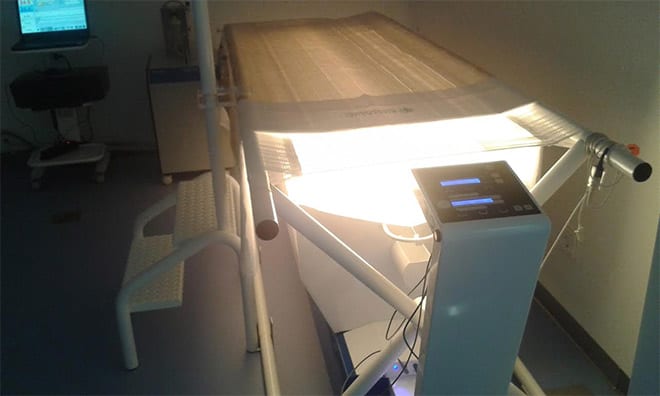
Hyperthermia has been shown to be indicated for treating systemic scleroderma (AKT DERMATOL 1993) and reducing Raynaud's phenomenon.
We have been treating autoimmune diseases of this type for some time, in which the body produces an auto-attack response from the immune system against the body itself.
