
- Home
- The Clinic
- Pathologies
- Techniques / Technology
- INUSpheresis®
- Clinical Analysis
- Blog
- Contact
The percentages of positive, negative, and inconclusive results are similar in studies on homeopathy and conventional medicine, but reports on conventional medicine are much more numerous.

In data up to 2014, there were 189 trials on homeopathy in peer-reviewed journals. Of these 189, 104 trials were placebo-controlled, suitable for detailed analysis. And of these 104, 41 percent, or, 43 trials concluded that homeopathy was effective..
All of this highlights the need for further studies in homeopathy. And this difference in studies is understandable when one considers the small budget allocated to research in complementary medicine .
We will cite a series of trials, in which no biased selection has been made, since we are not aware of any repetitions of these trials that have had negative results.
The following are examples of high-quality positive RCTs and meta-analyses/systematic reviews on different types of homeopathy:
Not all scientists say this. In an interview in Science magazine, Professor Luc Montagnier, who won the Nobel Prize in 2008 for his role in the discovery of HIV, when asked, "Do you think there is any basis for homeopathy?", replied, "... What I can say now is that high dilutions are correct. A very high dilution of something is nothing. There are water structures that mimic the original molecules."
The mechanism of action of homeopathic medicines is currently being investigated, and it is likely based more on physics than chemistry. What we do know is that many laboratory tests have shown that ultra-diluted homeopathic medicines have biological effects that would not be seen if they were simply water or sugar pellets, for example.
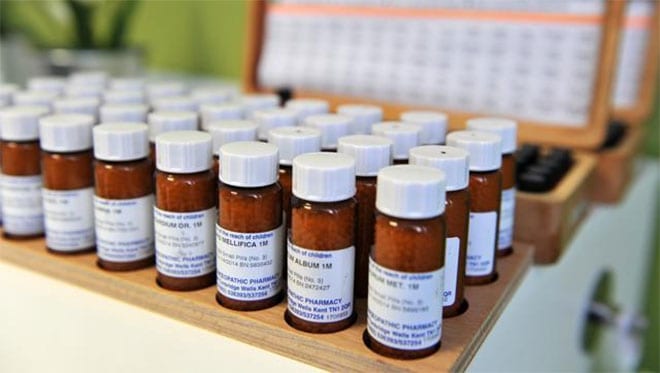
In the manufacturing process of homeopathic medicines, vigorous shaking or agitation of the diluted original substance is very important. If the substance is simply diluted over and over again, what remains in the end is, naturally, an inactive sample. Dilutions that have undergone shaking can cause biological effects.
It is sometimes claimed that homeopathic medicines are just sugar pills that have no active ingredients and only have a placebo effect, i.e., the patient believes that the pills will cure them and this belief alone leads to a healing process.
However, this explanation has no scientific evidence, since:
In a country such as the United Kingdom, where the British Council for Research into Complementary Medicine has existed since 1982 and there are homeopathic hospitals in London and Glasgow, the annual pharmaceutical expenditure of the National Health Service amounts to £11 billion, while spending on homeopathic prescriptions is £152,000.
Studies have been conducted on many diseases that show that homeopathy can have the same or better effects than conventional medicine.
For example, in the
The only study conducted showed that homeopathic trials were of higher quality than the conventional trials with which they were compared.
110 homeopathic trials and 110 comparable conventional medicine trials were compared. It was found that 21 homeopathic trials and 9 conventional medicine trials were of superior quality. In other words, the quality of research needs to be improved in both areas.
Six comprehensive systematic studies have been conducted on homeopathy, with five studies yielding positive results and only one yielding negative results.
The Lancet study or Shang's 2005 article, which is cited as negative and claimed that homeopathy was only a placebo effect, has been contradicted by five other articles, criticized for containing serious flaws, and replaced by the 2014 article by Mathie et al.
Based on the central principle that like cures like, i.e., a substance in large doses can cause symptoms but can be used in tiny doses to treat similar symptoms, homeopathy has been criticized. However, this idea is not new to science and, in fact, this concept, called hormesis, has been discussed for a long time.
There are also examples in conventional medicine of like curing like. For example, digitalis causes arrhythmias in high doses, but is used in low doses to treat them. And to desensitize allergic patients, low doses of allergens such as pollen are used.
In homeopathy, however, there is one advantage: the doses used are so small that toxic side effects are avoided.
The same thing happened with a conventional medicine such as aspirin. Its mechanism of action was unknown, yet it had been in use for more than 70 years before it was discovered in 1971.
The prestigious British Medical Journal determined that 46 percent of some 2,500 treatments commonly used by the British Health System are of unknown effectiveness, and only 13 percent have been proven to be beneficial.
Homeopathy cannot be considered, as its critics do, a pseudoscience, since scientists from highly prestigious universities, research institutions, and hospitals around the world are researching homeopathy using the same research techniques as those used for conventional medical treatments.
In any case, research into homeopathy is very new, and if there are fewer published articles, this is not surprising when you consider the difference in funding compared to conventional medicine.
