
- Home
- The Clinic
- Pathologies
- Techniques / Technology
- INUSpheresis®
- Clinical Analysis
- Blog
- Contact
Many diagnoses of autoimmune diseases are considered definitive, and no further progress is made in the search for the causes of the disease. Nor in its treatment.
On the other hand, Lyme disease itself can cause a disorder in the immune system that could be the source of autoimmune diseases. In any case, if a disease diagnosed as autoimmune does not improve with treatment, and its symptoms coincide with those of Lyme disease, it is highly recommended to seek a second diagnosis with simple and very effective tests for the patient, such as Lymecheck.
Autoimmune diseases are caused by the necessary convergence of two factors, genetic and environmental, compounded by a failure in the body's immune regulation, which is usually caused by an imbalance in the gut microbiota.

Talking about autoimmune diseases in general opens up a wide range of very diverse symptoms. The symptoms of Lyme disease can also occur in various stages, depending on their type and intensity. However, there are five symptoms that are common to all stages of Lyme disease:
Don't they also match the main symptoms of rheumatoid arthritis, multiple sclerosis, or Crohn's disease?
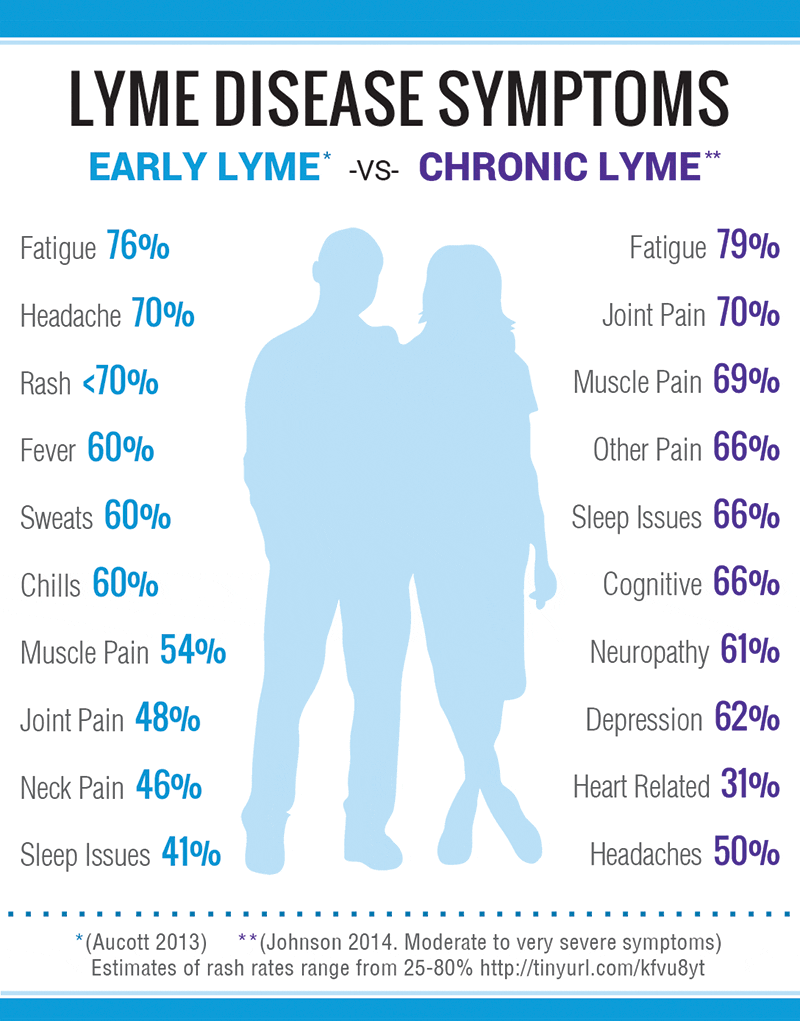
Lyme disease shares symptoms with autoimmune diseases such as multiple sclerosis, Crohn's disease, and rheumatoid arthritis.
RHEUMATOID ARTHRITIS
Joint swelling and pain is a characteristic symptom of osteoarthritis and also appears as the symptom related to the musculoskeletal system that is most characteristic of Lyme disease.
Scientific literature warns that arthritis that persists after treatment for Lyme disease may be, rather than a symptom in the joints, systemic arthritis caused by the alteration in the immune system triggered by Lyme disease itself.
The symptoms of osteoarthritis are:
AMYOTROPHIC LATERAL SCLEROSIS. ALS
When nerve cells age or are destroyed, they cannot send commands to the muscles, resulting in muscle weakness or an inability to move the legs or arms. This is, in simple terms, what happens with ALS, a disease that, in 10 percent of cases, is caused by a genetic defect. This is a neurodegenerative disease, and its relationship with Lyme disease has begun to be studied.
Sarah and John Vaughter published the paper When ALS is Lyme, in which they studied the similarities in symptoms, geographical incidence patterns (in the United States), the higher prevalence of Borrelia infection among ALS patients, and the success stories of patients who recovered after receiving treatment for Lyme disease. Although it is not known how Lyme disease can cause, influence, or mimic ALS, there does appear to be evidence to investigate this relationship.
The symptoms that overlap in both diseases are:
MULTIPLE SCLEROSIS
The symptoms of multiple sclerosis can affect the muscles, intestines, and other internal organs, and can be ocular or neurological, causing pain or muscle spasms. We have discussed the difference between the two diseases on other occasions. Although there are some common symptoms, we can make a causal diagnosis of the disease, taking into account even co-infections associated with Lyme disease.
CROHN'S DISEASE
On numerous occasions, the first symptoms of Crohn's disease to appear are known as extraintestinal symptoms and may occur even years before intestinal symptoms. In this case, we can highlight inflammation and joint pain, as these coincide with Lyme disease.
