- Home
- The Clinic
- Pathologies
- Techniques / Technology
- INUSpheresis®
- Clinical Analysis
- Blog
- Contact
The news of a patient diagnosed with Crimean-Congo hemorrhagic fever in Salamanca has once again brought the consequences of tick bites to the attention of the media.
This is a well-known and, fortunately, diagnosed case that we can become familiar with. This year, colonies of ticks, mosquitoes, and other animals have proliferated; rain and the lack of maintenance of roads and meadows due to the pandemic have caused grasses and other types of vegetation to grow more than normal, favoring the multiplication of these mites, the ticks, which we have talked about on other occasions.
Is this a problem? According to the World Health Organization, diseases transmitted through direct or indirect exposure to animals and their environment—zoonoses—cause more than 2.5 million deaths each year. Zoonoses can be transmitted through food, when infected animals enter the food chain and pathogens reach our bodies, as has been determined to have happened with the spread of SARS-CoV-2 or COVID-19. spread of SARS-CoV-2 or COVID-19.
Another important group of zoonoses are contracted through contact with infected animals, such as avian influenza. Finally, there are diseases transmitted by vectors—organisms that spread infectious agents from an infected animal—which account for 17 percent of diseases worldwide.
It is these that we want to focus on when discussing disease prevention. The best-known vectors are mosquitoes, which, in their different species, can transmit dengue, malaria, yellow fever, Zika virus, chikungunya, or lymphatic filariasis. Other vectors can transmit leishmaniasis, Chagas disease, plague, or murine typhus. And it is ticks and their different species that transmit a large number of other diseases: Crimean-Congo hemorrhagic fever, encephalitis, typhus, ehrlichiosis or tularemia, or Lyme disease.
Crimean-Congo hemorrhagic fever and Lyme disease are transmitted by different species of ticks, but what they have in common is a variety of symptoms that are not always diagnosed correctly. However, if one of the two diseases can confuse a diagnosis, it is Lyme disease, the great imitator.
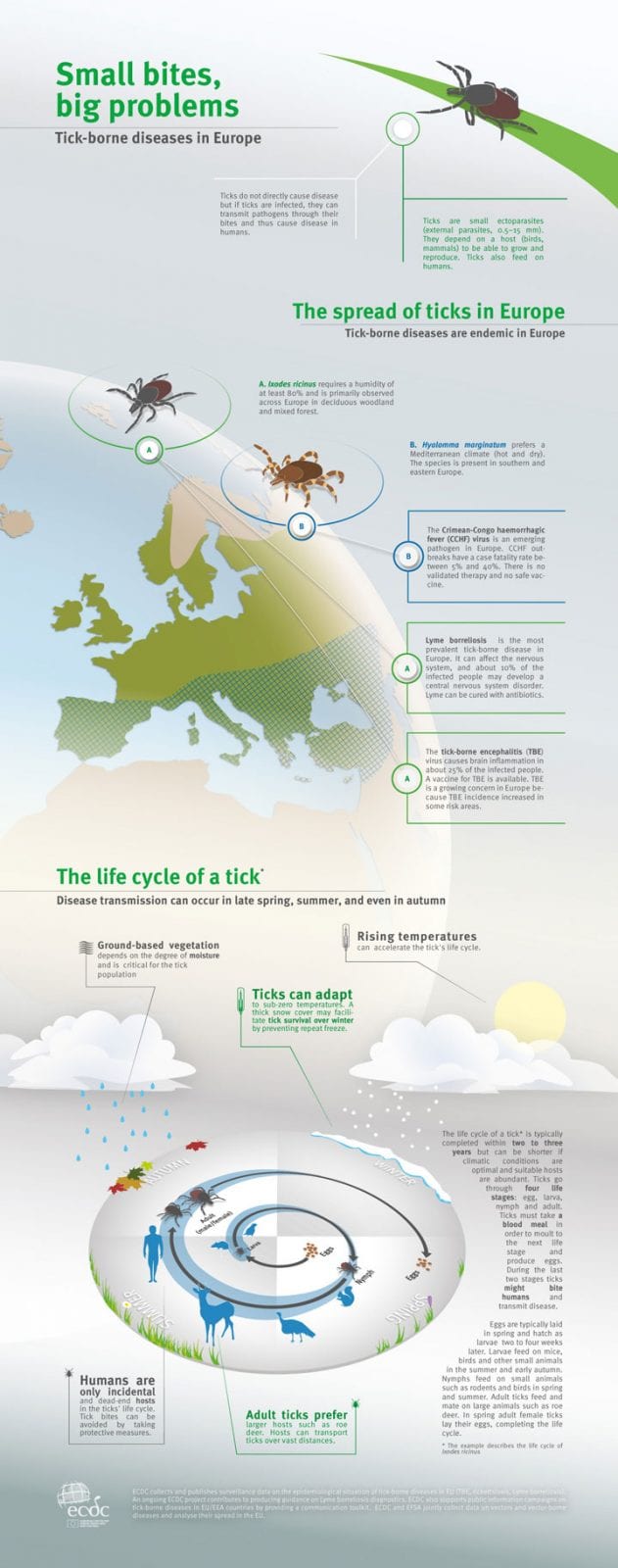
Some of the best-known zoonotic diseases are those transmitted by mosquitoes, but what about diseases transmitted by ticks? As the European Centre for Disease Prevention and Control warns us, small bites can cause big problems. At Biosalud Day Hospital, we believe it is crucial to develop awareness campaigns that enable us to prevent these bites and to increase the specialization of professionals who will increasingly be dealing with these types of serious problems.
The consequences of these bites can stay with us for the rest of our lives without us knowing that our illness and deterioration comes from a tick.
On the one hand, it is important to be aware of the presence of these animals and to know what they look like. A tick can be as small as the head of a pin and therefore imperceptible if it has attached itself to our skin in a hidden area of the body such as the scalp.
Ticks jump from plants onto our bodies. They tend to be found at the top of grasses, making it easy for them to access medium-sized animals, such as dogs, and people.
Our advice is:
– Read our 10 tips for preventing Lyme disease –
But what happens if, despite all the preventive measures, you don't notice the bite? If the tick is infected with Borrelia bacteria, you can develop Lyme disease or one of its many associated infections.
At Biosalud Day Hospital, we believe that understanding the disease, its stages, and possible symptoms is just as important as prevention. In our experience as specialists in this disease, we have met many patients who were frustrated because they could not find a diagnosis for their serious health problems. Unfortunately, this is often due to a lack of specialized training in this and other pathologies that are considered rare but are already endemic in many areas.
High temperatures can accelerate the life cycle of ticks, which means they reproduce more quickly: the egg-larva-nymph-adult stages are shorter. The fact that the average temperature is rising in our country would explain why there are more ticks.
This year, in addition, herbaceous plants have grown more than in other years due to abundant rainfall in the spring and a lack of maintenance work on meadows, for example. Humidity favors a larger tick population. These mites are so resistant that they can withstand sub-zero temperatures.