- Home
- The Clinic
- Pathologies
- Techniques / Technology
- INUSpheresis®
- Clinical Analysis
- Blog
- Contact
Cervicalgia is a medical term that comes from Latin and means neck pain.
Neck pain can indicate problems due to overuse, usually of structures in the cervical spine. Only in rare cases is neck pain or cervicalgia a sign of a systemic disease. Although the pain can be severe, the good news is that most people with neck pain improve within 1 to 2 weeks, and the vast majority of episodes improve within 8 to 12 weeks.
Neck pain affects 10% of the population each year.
Whiplash from traffic accidents is a common cause of neck pain.

The diagnosis of neck pain is determined by medical history and physical examination, and rarely requires expensive or uncomfortable tests.
The cervical spine is the most mobile part of the spine: it is believed that we move our neck about 600 times per hour. The cervical spine consists of seven vertebrae, linked together by vertebral discs and held in place by muscles and ligaments. Nerves branch off from the cervical spine, providing sensitivity and motor function to the arms.
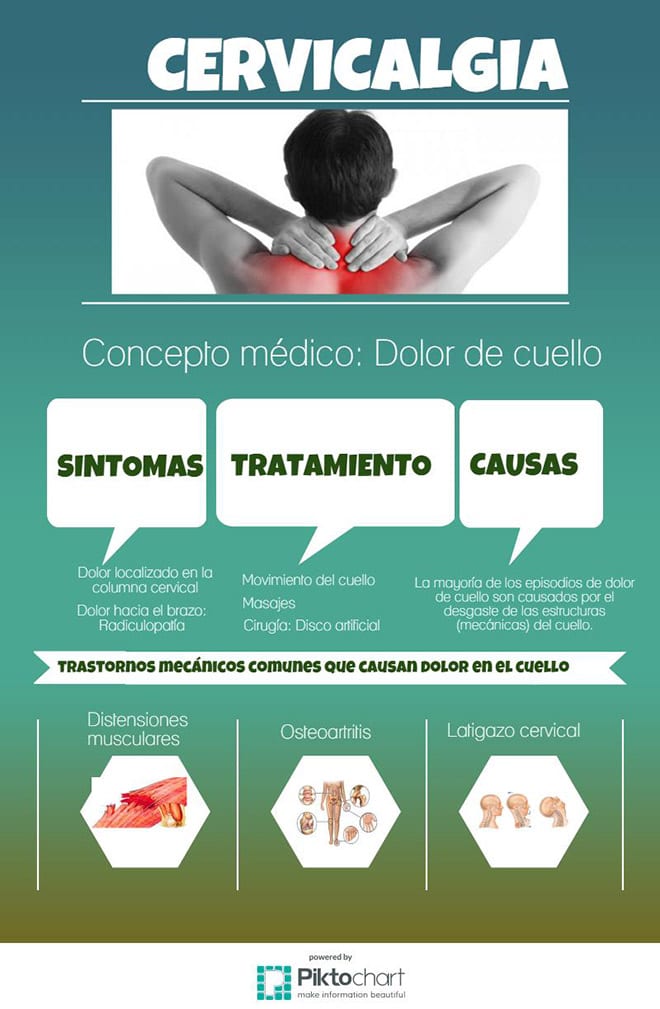
Neck pain is just that: pain in the neck. The pain may be localized in the cervical spine or may radiate down into an arm (radiculopathy). All age groups are at risk for neck pain. People who sit looking at a computer screen for long periods of time may be at greater risk. About 10% of the population has an episode of neck pain each year. Neck pain may occur slightly more often in women than in men.
Most episodes of neck pain are caused by wear and tear on the (mechanical) structures of the neck, which is associated with aging or overuse of the neck or arms. About 10% of cases of neck pain are associated with systemic diseases, such as polymyalgia rheumatica.
Common mechanical disorders that cause neck pain include the following:
In most circumstances, medical history and physical examination are the essential parts of an evaluation necessary for the diagnosis of neck disorders. In some cases, individuals who do not respond to initial therapy may undergo specialized radiographic testing, such as plain radiography, magnetic resonance imaging (MRI), or computed tomography to detect additional soft tissue problems, disc herniations, spinal stenosis, tumors, or nerve injuries.
Massage therapy has been shown to be helpful for people with chronic muscular neck pain.
Maintaining movement is an important part of therapy for neck pain. The use of neck supports should be kept to a minimum.
While regular exercise should be suspended until neck pain improves, neck movement is encouraged, with gradual movement in all directions. Neck movement extends to muscles that may be excessively tight. This exercise can be particularly helpful while standing under a hot shower.
Ice massages lasting 5 to 10 minutes applied to the painful area within the first 48 hours of the onset of pain can help relieve pain as they can warm and relax the muscles. Heat should be applied for pain lasting longer than 48 hours.
Individuals with higher stress levels may have tightened neck muscles. Massage therapy has been shown to be helpful for people with chronic muscular neck pain.
A small minority of patients with neck pain, particularly those with arm pain or signs of spinal cord compression, require cervical spine surgery. A new option for neck surgery is an artificial disc. This metal and plastic device is the right choice for a very small number of people with only neck pain and no other abnormalities in the cervical spine other than a worn disc.